


Page 68 - ASF Katalog 2018 en
P. 68
9

          WALINGS


          Fixing walings

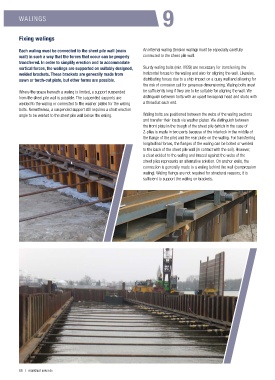
          Each waling must be connected to the sheet pile wall (main   An internal waling (tension waling) must be especially carefully
          wall) in such a way that the forces that occur can be properly   connected to the sheet pile wall.
          transferred. In order to simplify erection and to accommodate
          vertical forces, the walings are supported on suitably designed,   Sturdy waling bolts (min. M39) are necessary for transferring the
          welded brackets. These brackets are generally made from   horizontal forces to the waling and also for aligning the wall. Likewise,
          sawn or torch-cut plate, but other forms are possible.  distributing forces due to a ship impact on a quay wall and allowing for
                                                                the risk of corrosion call for generous dimensioning. Waling bolts must
          Where the space beneath a waling is limited, a support suspended   be sufficiently long if they are to be suitable for aligning the wall. We
          from the sheet pile wall is possible. The suspended supports are   distinguish between bolts with an upset hexagonal head and studs with
          welded to the waling or connected to the washer plates for the waling   a thread at each end.
          bolts. Nevertheless, a suspended support still requires a short erection
          angle to be welded to the sheet pile wall below the waling.  Waling bolts are positioned between the webs of the waling sections
                                                                and transfer their loads via washer plates. We distinguish between
                                                                the front plate in the trough of the sheet pile (which in the case of
                                                                Z-piles is made in two parts because of the interlock in the middle of
                                                                the flange of the pile) and the rear plate on the waling. For transferring
                                                                longitudinal forces, the flanges of the waling can be bolted or welded
                                                                to the back of the sheet pile wall (in contact with the soil). However,
                                                                a cleat welded to the waling and braced against the webs of the
                                                                sheet piles represents an alternative solution. On anchor walls, the
                                                                connection is generally made to a waling behind the wall (compression
                                                                waling). Waling fixings are not required for structural reasons; it is
                                                                sufficient to support the waling on brackets.


          68   |   mail@asf-anker.de

