


Page 29 - ASF Katalog 2018 en
P. 29
4                                  ANCHOR/WALING JOINTS


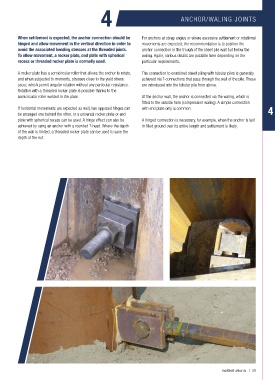
         When settlement is expected, the anchor connection should be   For anchors at steep angles or where excessive settlement or rotational
         hinged and allow movement in the vertical direction in order to   movements are expected, the recommendation is to position the
         avoid the associated bending stresses at the threaded joints.   anchor connection in the trough of the sheet pile wall but below the
         To allow movement, a rocker plate, end plate with spherical   waling. Again, various details are possible here depending on the
         recess or threaded rocker plate is normally used.      particular requirements.


         A rocker plate has a semicircular roller that allows the anchor to rotate,   The connection to combined sheet piling with tubular piles is generally
         and when subjected to moments, stresses close to the yield stress   achieved via T-connections that pass through the wall of the pile. These
         occur, which permit angular rotation without any particular resistance.   are introduced into the tubular pile from above.
         Rotation with a threaded rocker plate is possible thanks to the
         semicircular roller welded to the plate.               At the anchor wall, the anchor is connected via the waling, which is
                                                                fitted to the outside here (compression waling). A simple connection
         If horizontal movements are expected as well, two opposed hinges can   with end plate only is common.
         be arranged one behind the other, or a universal rocker plate or end
         plate with spherical recess can be used. A hinge effect can also be   A hinged connection is necessary, for example, when the anchor is laid
         achieved by using an anchor with a rounded T-head. Where the depth   in filled ground over its entire length and settlement is likely.
         of the wall is limited, a threaded rocker plate can be used to save the
         depth of the nut.


                                                                                                   mail@asf-anker.de   |   29

